Choose a mechanic: draw, split, compare, or draw cards
Choose Headcount to draw on a population-density map, Mapfold to eliminate countries with questions that split the possibilities, HigherQ to compare city populations, or Geo Blackjack to turn city populations into a press-your-luck hand. Each page owns a different action, so a population map game never has to mean four things at once.
Headcount: one loop, one official shot
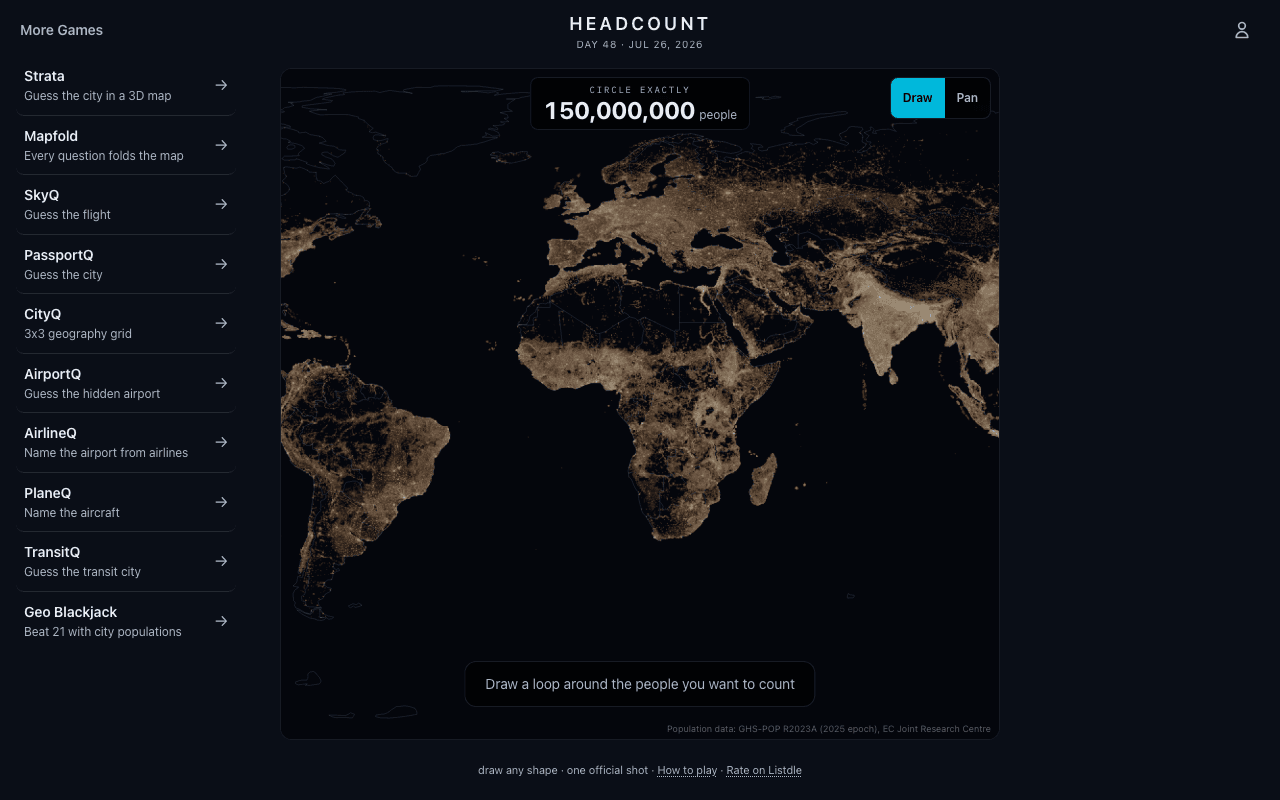
Headcount gives you a target such as 25 million people and a glowing world population map. In this draw-a-circle-around-population game, you make any closed freehand loop, inspect its area, and lock in one official attempt. Borders do not matter; the challenge is reading density well enough to enclose the requested number of people.
Mapfold and the split-the-map memory phrase
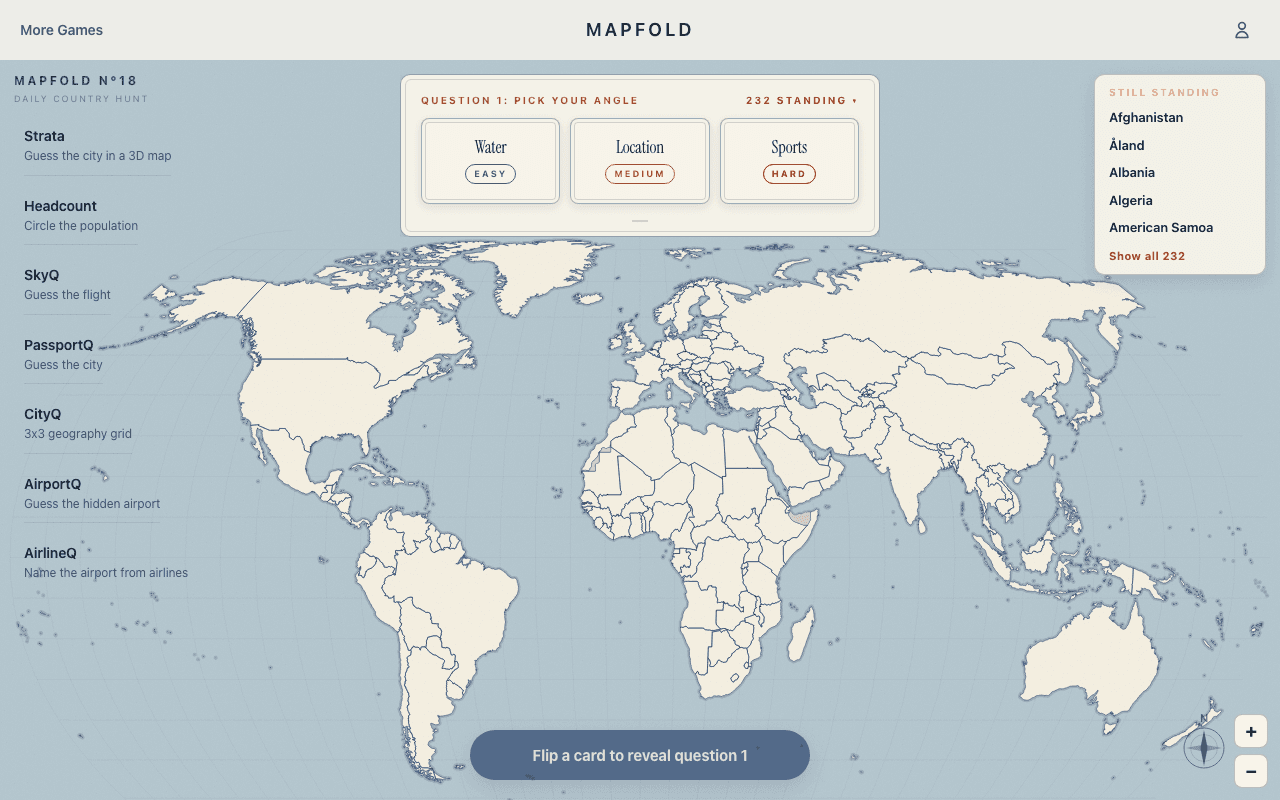
People often remember Mapfold as the game that splits the map in half by population. Population is one possible question, but the hidden answer is a country: each fact divides the remaining candidates and a miss folds the ruled-out part of the world away. It is a country-deduction game, not a population-balancing simulator.
HigherQ and Geo Blackjack: compare or play to 21M
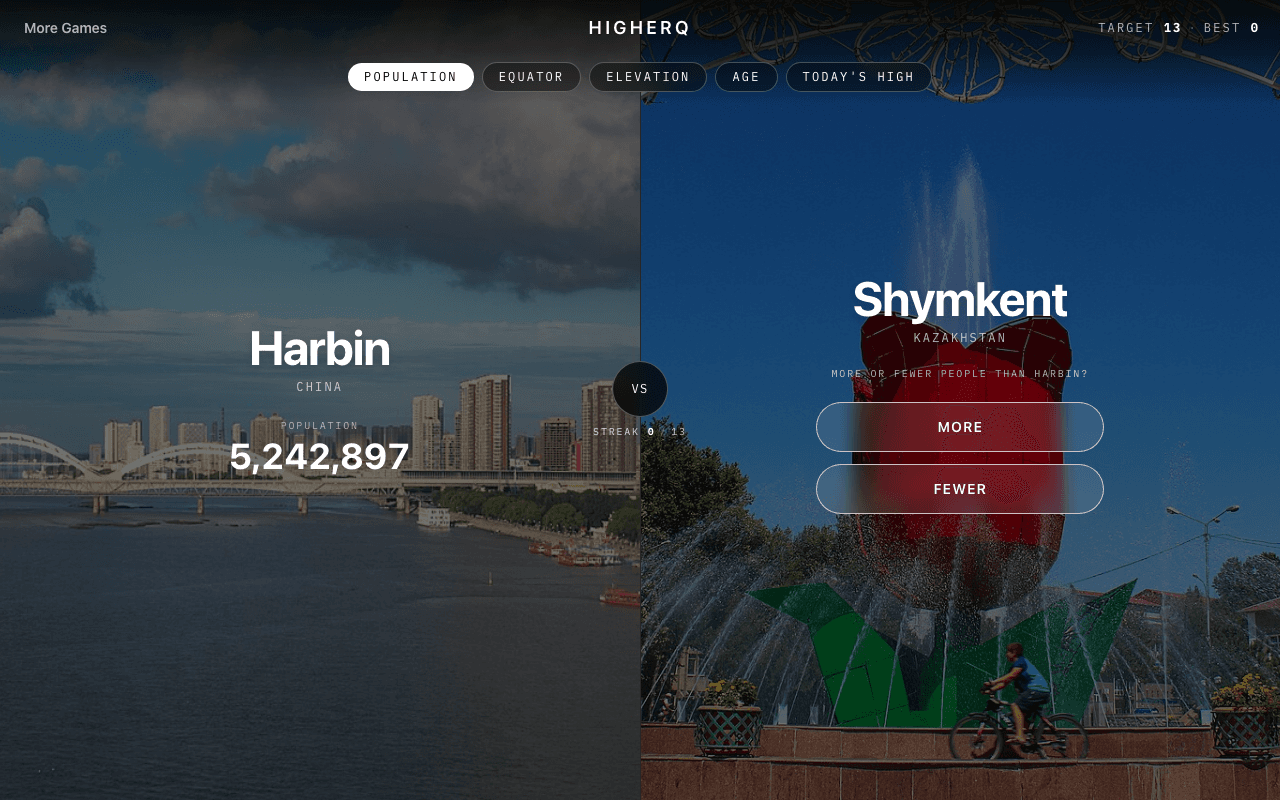
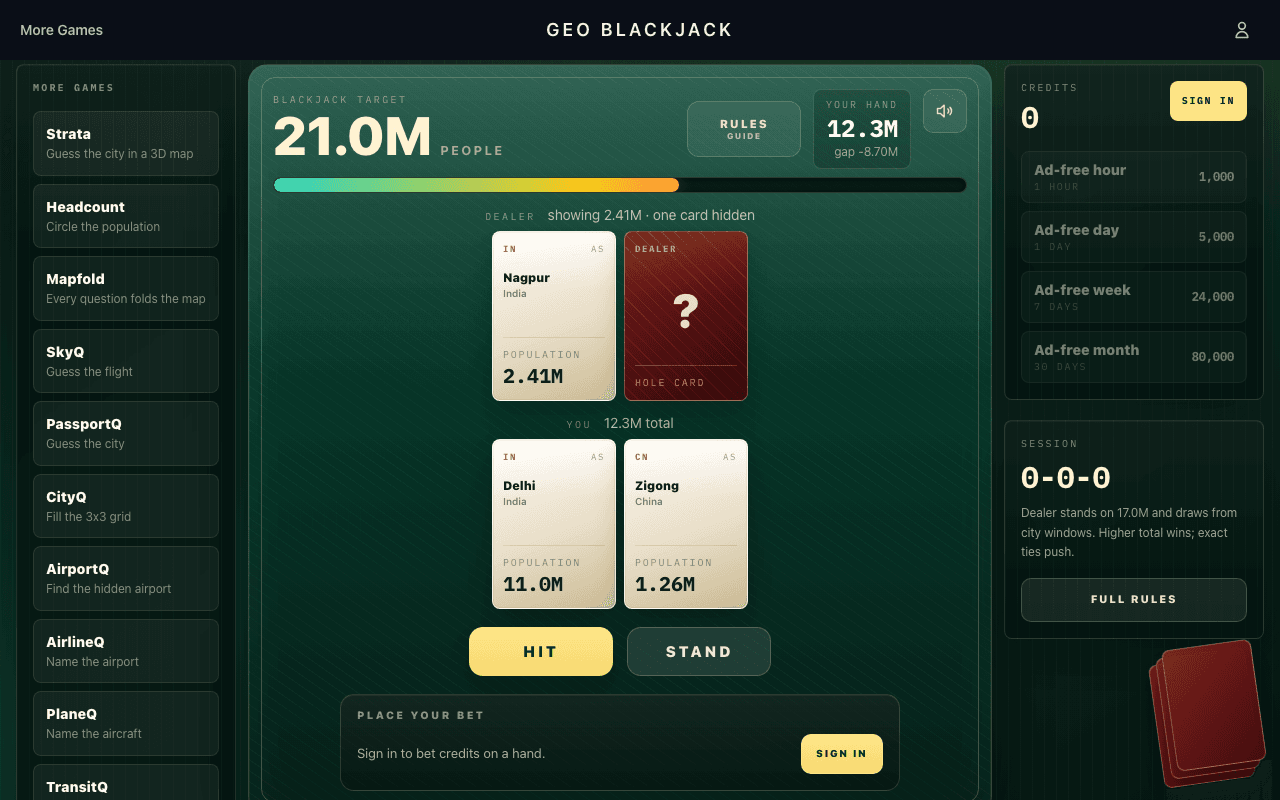
HigherQ asks which of two cities has more people and turns every correct comparison into an endless streak. Geo Blackjack uses city populations as card values: hit or stand against a dealer and try to finish near 21 million without going over.
What the population numbers mean
Headcount uses a modeled population grid, so it measures people inside the exact shape you draw rather than adding political units. The city games use a consistent city-population definition for fair comparisons. Estimates have reference years and boundaries, so the games teach scale rather than pretending every population figure is permanent or exact.