Choose your precision: Radius
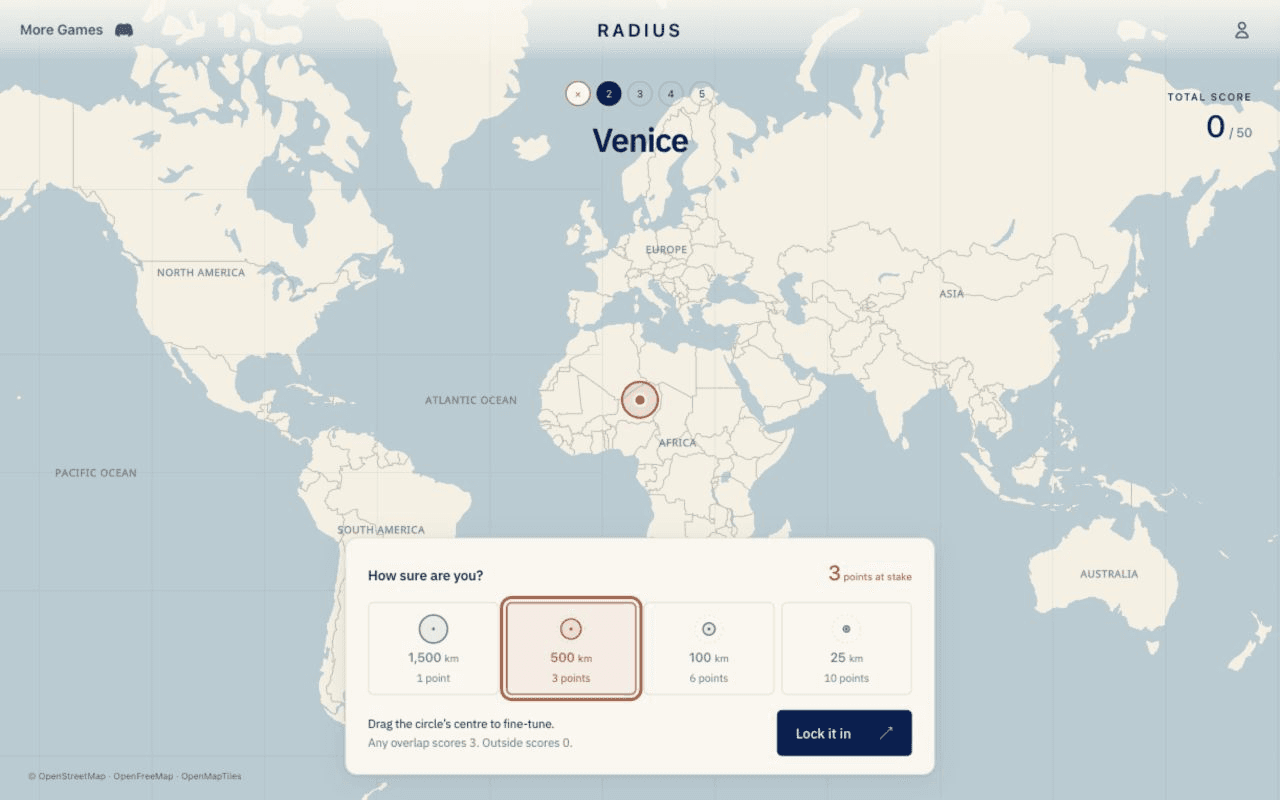
Radius names five cities and asks you to place a circle on the map. Choose a radius of 1,500, 500, 100 or 25 km for 1, 3, 6 or 10 points. Any touch or overlap with the city limits counts. Everyone gets the same five cities at midnight Eastern; yesterday is free and Premium unlocks older archived puzzles.
How the city clues work
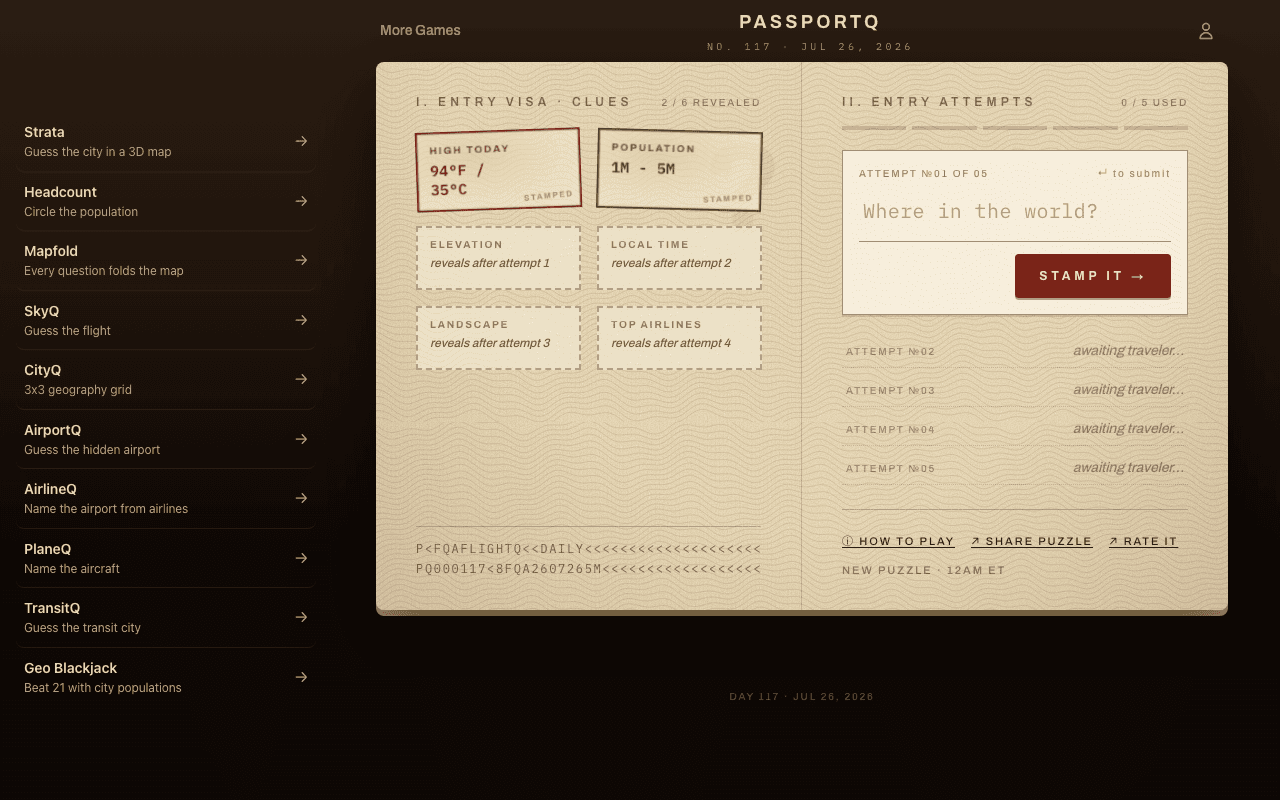
Every PassportQ puzzle starts the same way: one hidden city, five guesses, and two initial clues: the dated high temperature and population. From there the clue ladder opens up after each miss: elevation, local time, landscape, then airlines. Elevation tells you whether you are hunting a coastal port or a plateau capital. Local time slices the world into longitude bands before you have named a single country. Landscape and airline clues narrow the region further, and every wrong guess returns the exact distance and compass bearing from your guess to the answer. The pool covers more than 5,000 real cities, so the puzzle is rarely about recognizing an obvious capital. It is about narrowing the planet intelligently: each clue removes part of the map, and a good solver treats every guess as a measurement rather than a shot in the dark.
Why it feels different from a normal quiz
A standard city quiz asks whether you happen to know one fact. A city guessing game with feedback is closer to triangulation. Guess a city and learn the answer is 1,800 km to the northeast, and you have not failed — you have drawn a circle on the map. Combine that bearing with a cold daily temperature and a high elevation and entire regions disappear at once. That loop is why the format holds up as a daily habit: even when you do not know the answer, you can reason toward it, and when the solution appears you learn exactly where your mental map was stretched or compressed.
PassportQ vs Citydle vs Satle
The city-guessing genre has several strong takes, and they reward different skills. Citydle is the most Wordle-like: a daily mystery city with clues revealed guess by guess, a good fit for players who want quick fact-based deduction. Satle hides the city behind a satellite photo, so the puzzle is visual — the pleasure is recognizing a coastline or street grid from orbit. City Guesser on virtualvacation.us drops you into real video and street footage and asks you to pin the location on a map, which makes it the best choice for unlimited, non-daily play. PassportQ's angle is data-driven deduction with navigational feedback: instead of a photo or a fixed clue list, every wrong guess returns distance and direction, so the puzzle converges even when the answer is obscure. If you like inferring places from numbers and maps, start with PassportQ. If you prefer reading images, Satle or City Guesser will fit better, and if you want the purest daily word-game rhythm, Citydle is a solid pick. Plenty of players rotate through more than one.
More ways to guess cities on FlightQ
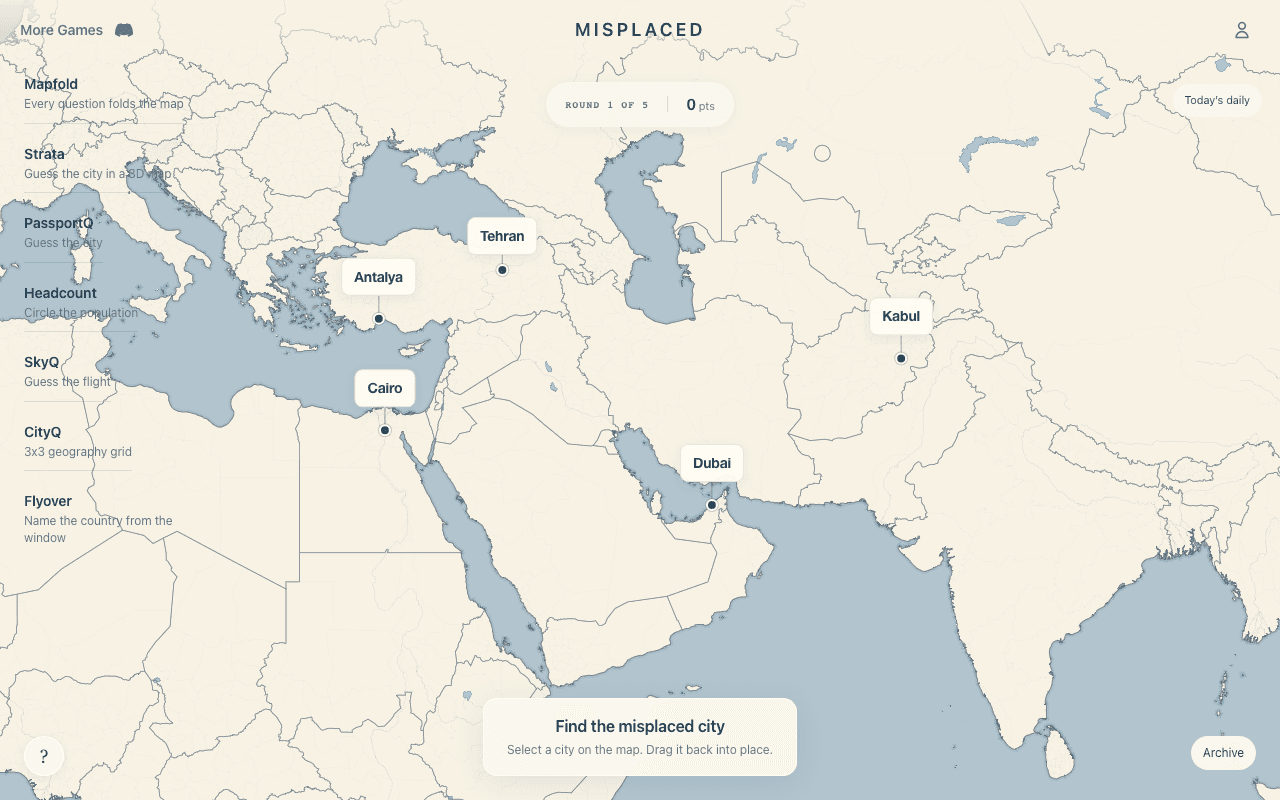
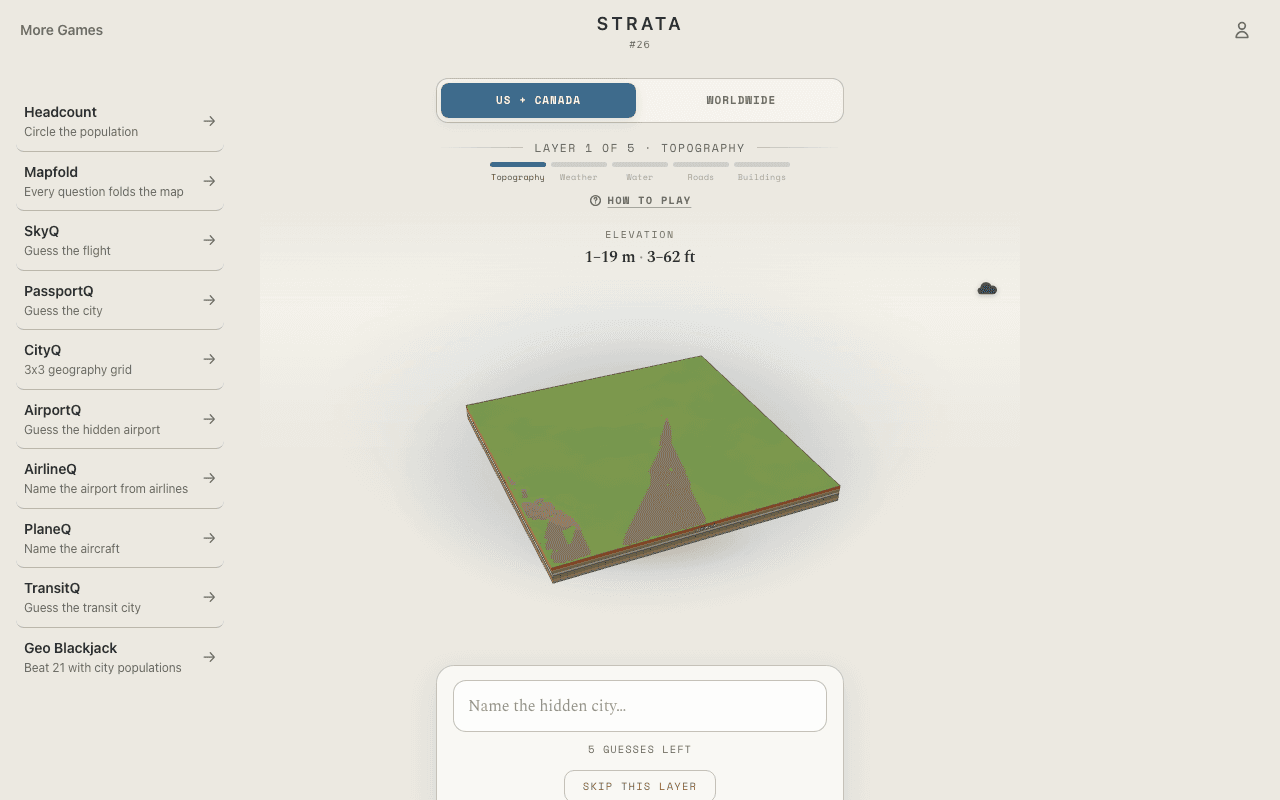
PassportQ is the anchor, but the city habit branches. Strata renders the mystery city as a real 3D map revealed layer by layer — bare terrain first, then water, roads, and buildings — so you guess from the shape of the place itself. CityQ turns city knowledge into a daily 3x3 grid where each square needs a city matching both its row and column clue. Chain asks you to keep naming cities that fit a category with 30 seconds per answer. HigherQ compares two cities by population, elevation, age, distance from the equator, or today's high temperature in an endless streak. Geo Blackjack deals real city populations as cards and dares you to stand near 21 million without busting.
Tips for solving the daily mystery city
Strong openers are cities you know cold: a guess only helps if you can interpret the distance and bearing it returns. Use local time early — it is the fastest longitude filter in the game. Treat temperature with care, remembering hemisphere and season, and let elevation veto guesses that the bearing alone would allow. In the endgame, think in pairs of plausible neighbors: when two candidate cities sit in the same region, the airline and landscape clues usually break the tie. Most importantly, spend guesses deliberately. Five is enough to bisect the planet if each one is placed to split the remaining possibilities.